- Follow us:


Friday, April 29th, 2016
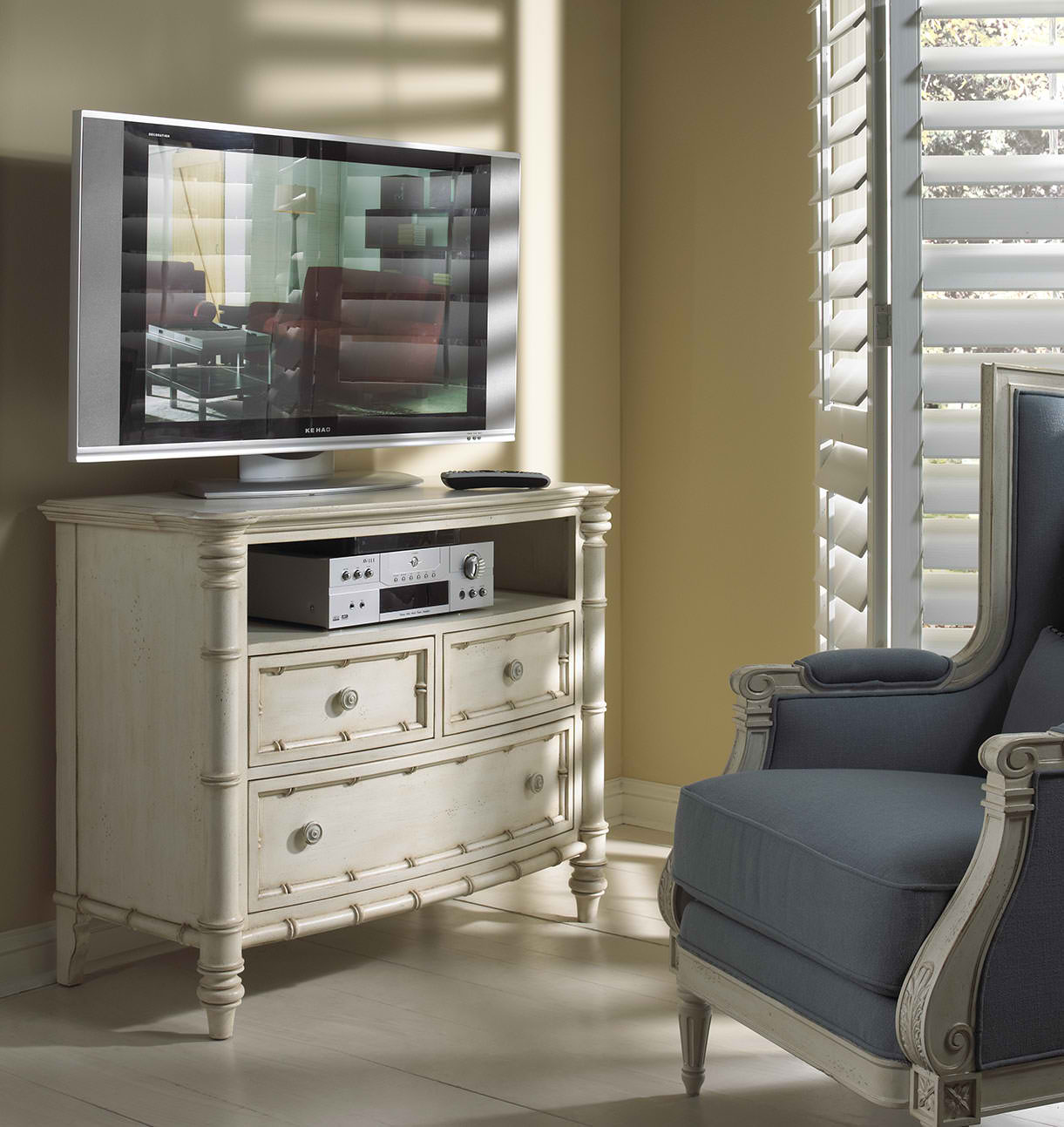
FFDM’S Summer Home Collection is featured in this corner of a home. Foamed furniture such as the chair here is effective in controlling the overflow of sound.
The open floor plan concept in offices came into existence in the 1960s. Since then, hundreds and thousands of companies all over the world, embraced this concept. Some believe this concept is a source of stress, noise and nuisance. If you look at this floor layout, though, you would immediately begin to see the benefits that it offers.
The open floor plan fosters collaboration among employees. This used to be imposed among workers which made it one of the most used layouts in the world today.
In France, alone, individual cubicles exist as a minority. About 34% of employees still work in partitioned workstations according to a 2015 study.
The early 20th century showed that the open offices flourished. Frank Lloyd and the likes of him perceived the partitioned office as a facist, totalitarian trend. Because of this perception, more flexible plans allowed employees to be free from the confines of small work areas.
Right after World War II, the development of the tertiary sectors was accompanied by a new perception on the workplace. The idea of an open workspace originated in the 50s in Germany. Eberhard and Wolfgang Schnelle came up with the idea of an office landscape where partitions are no longer a necessity.
The work areas were decorated with green plants fostering open communication among the workers. By 1964, Herman Miller, an American company, came up with Action Office Series 1. These were modular offices that were created with panels and various workspace heights. These easily adapted to the workers’ various activities. It was observed that their interactions became more regular and their movements, more fluid.
It was in 1968, though, that Robert Probst came up with the cubicle which is an office space with partitions that can be removed.
The Ultimate Family Design
The open floor plan can be the best kind of family or entertainment space but if you bring in the kids and pets to the picture, you would end up with discord.
This is why there is a need to understand your tolerance level if you are choosing to employ the open space layout in your home. You might have started with how you will use the space on hand but you might have forgotten about the possible noise that could come from family members, pets and appliances. This is especially true if the room features audiovisual components.
Always think of sound as something that is liquid. Water will always look for a place to flow to so it can seep through spaces and cracks.
This is also true with sound. You need to plan for an escape route for any kind of noise.
Consider also the shape of the room. Surfaces made of stone, metal or concrete tend to bounce sound at a louder level.
If you want a modern, clean, no-curtain room, then see if you can install rugs that would deaden the sound. Know how to control the noise by lowering the ceiling, having the columns in a room wrapped in wood, or replicating this kind of ceiling along the rooms.
Should noise become an issue, then it is best to break up the rooms by creating doorways in between the living areas. There is no other way to contain the sound without disturbing the flow.
Interior designers know that fabrics can be used to muffle sound. Empty rooms are noisy but once you bring in the furnishings, draperies, especially the carpets, you would soon notice that the room has become a lot quieter.
Use same color on your walls and draperies. Add texture as well as interest without totally closing off the other rooms. Make good use of soft surfaces like upholstered pillows and chairs to manage the sound.
Tags: 1950s, 20th century, homey, homey ambiance, homey ambience, homey interiors, McCreerys, McCreerys Home Furnishings, open floor, open floor layout, open floor plan, open floor planning, open space, open space design, open space layout, open space theme
Posted in Interior Design 101, Interior Design Elements, Interior Design Themes | No Comments »
Friday, February 12th, 2016
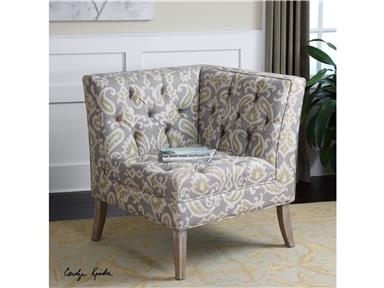
Living Room Uttermost Meliso Tufted Corner Chair 23167
Have you ever heard of the term Ikat? This is actually a kind of fabric that has been woven, dipped and dyed in almost the same way as tie-dyed stuff. The creation of Ikat prints is time consuming, hence, it was a symbol of power and wealth among Indonesians.
Ikat became available to interior design just a few years back. John Robshow, a famous fabric collector, as well as Madeline Weinrib, took Ikat and turned it into a high-end material. Soon, Oscar dela Renta also used the material on their scarves, bags, dresses and shoes.
The Ikat Technique
Ikat is a technique of resist dyeing that is used in making textile patterns. Resist dyeing often involves covering some parts of the fabric to shield them from the dye’s penetration. Thread is wound around the fabrics then wax is applied to the cloth’s surface (batik).
Ikat, in contrast, is a process done before weaving, warping or wefting. To come up with the patterns, the threads are first set on a frame. Several threads are then grouped then tied all at once. This results in knot units where the overall pattern made obvious.
Resist ties are then removed or some are added for every color. The combinations give birth to the designs. As the dyeing is completed, every single one of the resists is opened then the patterned yarns are finally woven.
Ikat is a Malay-Indonesian term for tie. Depending on whether tied fibers are used on the weft or warp, the technique can be called either as weft ikat or warp ikat. The double ikat is known as the third variety. This mixes the weft and warp tied resist.
The pattern becomes visible through the use of a major resist-dyed thread system. Warp ikat makes use of weave that is warp-faced while weft ikat has a weft-faced look.
Plain weave is best for showcasing the ikat design. Weft ikat which is a twill weave, can also be used.
Double ikat is ideally woven using a balanced weave, with weft and warp both visible. Any kind of textile fiber can be used to create ikat, though cotton and silk are quite common.
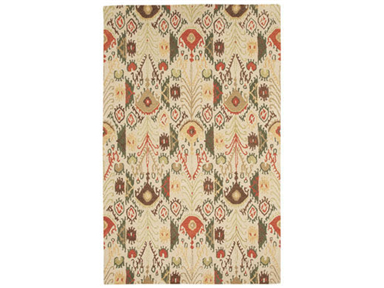
Capel Incorporated Floor Coverings Ikat 3′ x 5′ Rug 3261RS03000500800
More Ikat History
It is not established where and when the resist technique first came into existence. Asia comes with cultural regions with strong ikat culture. India, Central Asia and Maritime Southeast Asia are all candidates for where the technique originated.
Ikat could have evolved earlier, though. The Austronesian world also knows of this technique of tie dyeing. Madagascar and Indonesian ikat traditions seem to have similarities.
The earliest productions of ikat have also been seen in Peru, Chile, Guatemala, even Nigeria and Ghana. The Mediterranean region and Europe answered with ikat when Islamic textiles became renown. Italy soon welcomed this lovely print during the 17th century. The rest of Europe including Spain and France also started to produce these lovely prints.
The 19th and 20th centuries witnessed how Asia produced quality ikat textiles. Countries such as Japan, India and the rest of Asia produced these quality textiles in abundance. China, though famous for textile production, was not able to develop this technique.
India and the rest of Southeast Asia are the regions that offered more diverse ikat designs. Andhra Pradesh, Gujarat and Orissa proved to have their own ikat traditions. The sari-length silk cloths were soon manufactured in double ikat by Patan weavers.
Ikat designs, even to this day, require precision and a great amount of planning. If you have one in your home, then you are in possession of a piece that has weathered the test of time.
Tags: 19th century, 20th century, Asian design, Asian style, geometric patterns, ikat, ikat design, ikat patterns, ikat prints, Indian, McCreerys, McCreerys Home Furnishings, patterns
Posted in Interior Design 101, Interior Design Elements, Interior Design Themes | No Comments »
Friday, January 29th, 2016
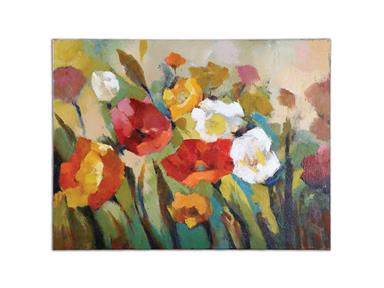
Accessories Uttermost Spring Has Sprung Floral Art 34268.
There is nothing more expressive when it comes to designing a home than the use of art. Art accessory comes in many forms but one of its most beautiful forms is a painting. Vibrant colors and rich textures can be infused with other design elements.
There are many media and styles featured in famous paintings, even repros. It is easy to find some pieces that can match your chosen theme and also your personality.
Watercolor paintings work best in achieving a softer look. This medium shows multiple layers of color ranging from abstract to life-like. For added contrast and detailed shading, find oil or acrylic paintings. These, on the other hand, feature mixed colors in various textures.
Painting History
The history of this art medium goes back a long way. Every style is born from the one that came ahead of it. Each artist also adds to the achievements of the early painters and is able to influence the next generation of painters.
Paintings can be enjoyed for their sheer beauty alone. But for the keen eye, their colors, forms, lines and composition appeal to every sense. Paintings can even leave lasting impressions.
The enjoyment of paintings is not the sole purpose of this kind of art. It can be used to convey a deeper message than mere beauty. It can express the artist’s impression of persons and scenes, even events. Feelings can also be described with the use of paintings. Viewers may or may not feel that emotions that are being conveyed by the artist. One needs a discerning eye for art in order to appreciate such things.
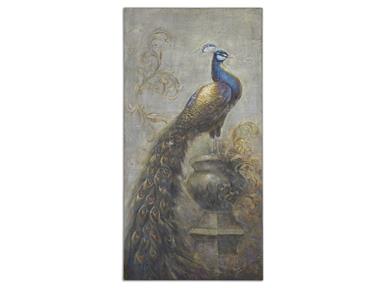
Accessories Uttermost Surveying The Kingdom Canvas Art 34283
Painting history can be encapsulated in these periods –
Man has gone a long way from the time when paintings were colored animal drawings inside caves. Cave dwellers were the first known painters, with their work found inside the caves of Spain and southern France.
Even back then, these cave artists knew that they needed vibrant colors to depict their lives back then. The famous painting of the wounded bison is still in the cave of Altamira in Spain today. While basic tools were used in the beginning, eventually, man learned to accumulate more materials and even learned techniques that improved his artwork.
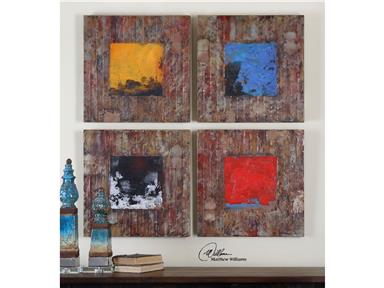
Accessories Uttermost Primary Blocks Wall Art S4 31303
You may not be able to take home an original Picasso, Monet or Michelangelo but there are still a lot of amazing paintings to go around. These days, the canvas can be the home for odd shapes, mere triangles, circles or rectangles in your sight but their bright colors and geometric patterns definitely mean something. It may even be difficult to distinguish between sculptures and paintings these days but the purity of hues and the shapes’ relationships are still there.
Artwork, as previously mentioned, comes in many forms. Clients are most familiar with the type that they can hang on walls inside their homes or offices. The next renowned pieces are tabletop artwork and sculptures.
Don’t get confused in choosing which medium you’d bring to your home or office. Just remember to show your personality through your chosen painting. Regardless of form, your taste and style should be reflected throughout the medium.
If you were a born optimist then it shouldn’t be a surprise to find brightly-colored paintings in your home. Black and white is for the stoic ones. What you have chosen based on your personality is a surefire validation that you have selected the right piece. Your art accessory is a representation of you so kudos!
Tags: 18th century, 19th century, 20th century, accent wall, art, art decor, artwork, choosing wall art, decorative painting, displaying artwork, history, McCreerys, McCreerys Home Furnishings, painting, paintings, Renaissance, rich hues, Rococo, shape, shapes, texture, textures, tips, wall decor
Posted in Accents, Decorative Elements, Interior Design Elements | No Comments »
Wednesday, January 27th, 2016
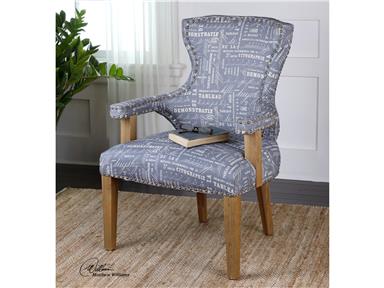
Living Room Uttermost Citographie Gray Linen Armchair 23168. This chair is made of hardwood and made perfect by craftsman detail right on the gray linen tailoring. See how the brass nails streamline the fabric trim giving the needed contrast to the solid oak bare frame.
Craftsman dwellings were inspired by architect brothers Henry Mather Greene and Charles Sumner Greene. These ingenious minds worked together during the 20th century in Pasadena, California. The Greenes were quite inspired by the English arts and crafts movement and Oriental architecture. In their own promoting handmade stuff rather than those created inside factories and were machine-made.
If you want to have a first-hand look at the beauty of craftsman design and architecture, you could visit Southern California where a few bungalows from 1905 till the 1920s still stand. You will surely love this style if you like things that may be old but have got a timeless appeal.
Characteristics to look for include gabled roofs, front porch, tapered columns, partly paned doors, multi-pane windows, and a lot of earthy colors.
Craftsman houses are typically painted in any nature-inspired color. You will see a lot of browns and greens. The low-profile homes often blend with their natural surroundings. The muted palette comprising of just one or two contrasting colors are used to highlight the breathtaking architectural features.
Regardless of the style that you choose for your home, keep in mind that painting an architectural feature with a contrasting color is an effective way to highlight such feature.
Another characteristic that is unique to a craftsman home is the stone detailing. See the mixture of different materials with the siding typically made of wooden clapboard. There are some that feature shingled siding as this was a pretty common style, too, back in the day. The foundations and porch piers are generally made of stone with some concrete block, bricks or stucco used at times.
Craftsman style also comes with roof eaves, exposed beams and rafter tails. All these reflect the influence made by the Arts and Crafts movement, thus, visible handiwork was featured and were considered in style.
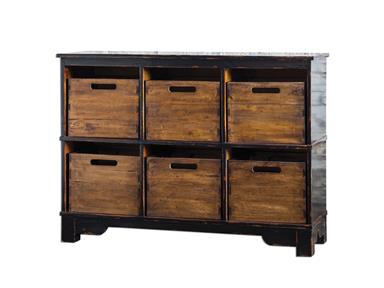
Living Room Uttermost Ardusin Hobby Cupboard 25589 is made from select hardwoods. It is hand-finished in worn black. The mahogany dovetail bins are solid wood and are great for your any storage needs.
Democratic Mixing
Get a craftsman style book and mix materials that you can get your hands on. Think of cladding a little addition of brick or stone even when your home already has existing clapboard siding. The addition of exposed rafter tails or beams should not mean that you are supposed to reconstruct your home or even replace your roof. Such details are commonly decorative in nature and can be easily added below a home that already has deep roof eaves.
There is something inviting and warm about a craftsman home. It celebrates the fusion of building materials, lovely structures, and most especially, the 20th century architectural features.
So, how to begin?
Start with a view of some of the craftsman homes still in existence. Take note of the window detailing, those exposed rafters, the facade, stained glasses as decorative accents, and the overall warm glow of the place.
Consider also the kind of lighting used which mirror the exteriors. Find sconce and pendant lighting that will cast a warm, golden glow throughout a room. While this is the general rule when it comes to craftsman homes (warm lighting plus earthy colors), this does not mean that you can’t put your own personality into it. You can opt for the bright home approach where you balance the bright hues with the wooden accents which are the staple materials of a craftsman home.
Other colors that you can add to your palette are white and blue. Gray can also give your craftsman home a contemporary appeal. Include white wooden accent pieces, modern pendant lighting fixtures, and some contemporary art. The result is a comfortable and trimmed yet modern and posh at the same time.
Isn’t it fun to make historical homes appear modern inside? This can be your take on retro meets the contemporary look.Craftsman design is sure to captivate both young and old spectators.
Tags: 20th century, 20th century chairs, arts and crafts, contrast, contrast in design, contrast in interior design, craftsman, exposed finish, hardwood, hardwood furniture, hardwood pieces, interior design contrasts, McCreerys, McCreerys Home Furnishings, mixing and matching furniture, pendant, pendant lighting, retro, Retro design, Retro style, tips, wall sconce, wooden elements
Posted in Furniture, Interior Design 101, Interior Design Elements, Interior Design Themes | No Comments »
Follow us on our social media


© McCreery's Home Furnishings | All Rights Reserved | Privacy Policy
