- Follow us:


Saturday, September 3rd, 2016
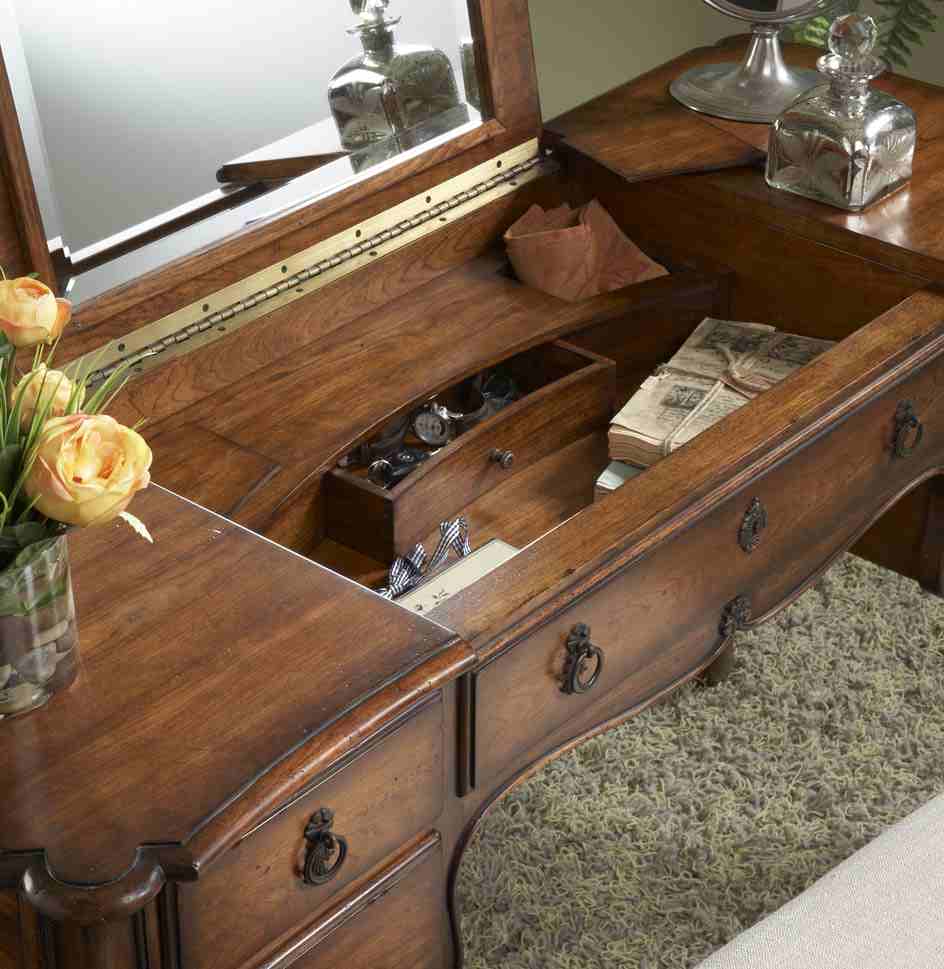
FFDM Vintage Classics provides just the right amount of traditional charm.
Traditional theme is often characterized by classic European décor. Furnishings come from the 18th to the 19th centuries in Neoclassical, English or Colonial Revival styles. French countryside, 18th century England, even the exotic lands from the East also work. These often include wood tones, beautiful architectural details, and chic lines. It is a posh style that may still be complemented with personal elements. This can be the perfect style for your home but are you ready to learn what elements you need to work on?
Essential Elements
The fundamental elements of traditional design are symmetry and classic styling. Both can create orderly, calm and elegant décor. Traditional style also means using soft, curvy lines and wing-backed chairs for furnishings. Talk of the Queen Anne design. The more antique-looking the piece is, the more that it would work for your traditional setup.
If you love furnishings made of dark woods like maple, cherry or mahogany, then you are the perfect candidate for a traditional style enthusiast. Tables, chairs and other furniture pieces that offer a luxurious appeal with carving and lacquer are the right pieces to look for.
While it is an elegant style, traditional design highlights symmetry when it comes to furniture layout. This means that you can use a pair of armchairs right in front of the traditional fireplace. You can also place a candlestick duo on the mantle or a huge wall art that would balance a neutral room.
The Best Traditional Color Palette
Neutral and muted mid-tone walls should be a part of the traditional style. Use different fabrics in solids, florals, plaids or stripes. The neutral walls will serve as the perfect backdrop for those upholstered chairs and sofas that come in rich shades of navy, brown or burgundy.
Green and peach tones will balance the marriage of tan and aubergine. This is an unfussy palette that would work for anyone who is on the lookout for sheer elegance.
The traditional palette can also be rich and deep and the home for anything that is regal yet muted. These colors also offer a timeworn effect which is typical in Old World pieces. Dramatic colors include forest green, cream, ochre and just about any dark-stained surface.
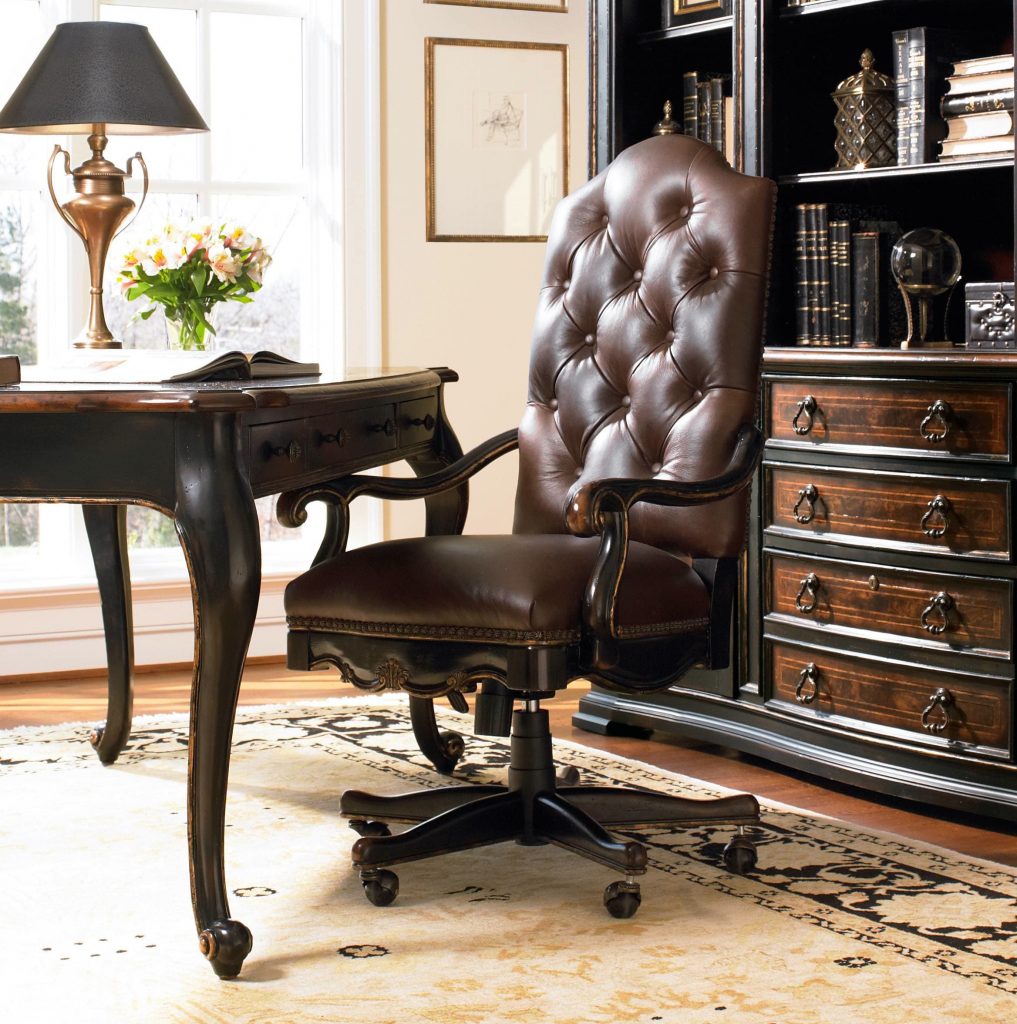
Hooker Furniture Home Office Grandover Tilt Swivel Chair fits perfectly in a traditional home office.
Textures and Shapes for Traditional Design
Though elegant, traditional design can also emphasize comfort and simplicity. Fabrics can come in damask, floral or paisley patterns. You are likely to see luxurious fabrics such as velvet, silk and cashmere. You can also use fabrics that are easy-to-care-for such as linen and cotton.
Go ahead and use luxurious accents such as throws and pillows. Small print on pillows can pair beautifully with floral-patterned sofas. Damask is the best choice for traditional design enthusiasts who want to achieve both a shiny and dull textures.
Another way that texture can be used in your traditional home is to have some still life paintings hung. To highlight this artwork further, invest in a chandelier or some silver candelabra. Polished ceramic jar surfaces as well as rustic wrought iron pieces will also render the perfect traditional look. Add some silk or fresh flowers in a vase and the look is complete.
The Traditional Window
Traditional design spells tailored windows with that formal swag and panel combo. Panels can be gathered using tasseled cords. The fringe can accent the swag treatments. These can add design details to scalloped edges.
Traditional Architecture
If you want to take the traditional look all the way to your home’s architectural features then have rough-hewn beams line a ceiling. These can easily balance the more chic elements inside the room. Other notable features include arched windows and doorways. Feminine curves can be used to balance a mainly masculine design.
Tags: 18th century, 19th century, design textures, McCreerys, McCreerys Home Furnishings, Old World interior design, textures, traditional interior design, traditional interiors, traditional style, traditional theme
Posted in Architectural Elements, Interior Design 101, Interior Design Themes | No Comments »
Thursday, June 2nd, 2016
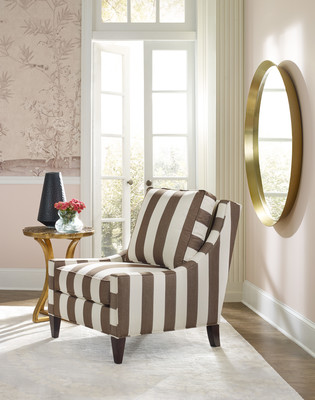
The geometric beauty of this Cynthia Rowley 1118CR Delancey Club Chair is great for this modern setup.
Modern design comprises various materials and perceptions. This is why this design can be a bit difficult to characterize. In fundamental terms, modern design is a reflection of modern art movement inside homes. There are many focal characteristics and themes that can be classified as modern design. Modernism is the exact opposite of more opulent designs including Renaissance, Gothic, and Victorian.
Modern Design: A Rich History
Modern interior design is just a small section of a much larger modernist movement. Modernism is often attributed to the end of the 19th century where modern thinking was given birth.
Modernists were bent on deviating from the creative, intellectual and cultural norms that have been set during the period of Enlightenment. Movements against organized religion and old norms and mores were established and the fusion of politics and creativity was given emphasis. Everything else after this fell under the category of modernism with the sub-genres defined as futurism, cubism, Bauhaus, abstract expressionism, Neo-Dada, and minimalism.
Here are some of the common components of what could be categorized as a modern home –
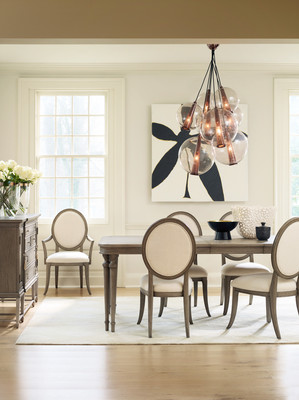
1586-75200-GRY1 Dinner at Eight Dining Table w 2-18in leaves: Notice the absence of curvy lines and complex designs in this modern dining room.
Everything Is Minimal
Minimalism is a huge part of modern design. The fundamentals of minimalism embraces the less is more concept. The design in a modern home does not include complex moldings, columns, cabinet trim, or excessive color on textiles.
Minimalism is living – not in scarcity but – in simplicity. It may look simple but this kind of style takes a lot of careful planning. This is necessary so that comfort is still attained while the layout is efficiently streamlined.
The open floor layout can join different rooms in just one space. The counter in a kitchen, for instance, can provide a visual division between the areas for cooking and the areas where people can sit down and converse.
Clean Lines
Modernism, simply put, is the exact opposite of previous interior designs what use carvings, heavy textures, and wood tones.
Majority of the components of modern rooms – from the furniture to room shapes – include straight, clean lines with no intricate details. These differ from contemporary design which can have some curves and sweeping, sharper lines.
With these said, there are different designs that fall under this furnishing category like Art Deco, Mission Style, and Shaker.
Paired with furnishings are oversized tiles, sanded wood floors (with minimized grain), shelves, bookcases inset in walls, open floor layouts with very few walls, and the lack of doors, windows, moldings and trimming.
Metal: The Star Material
Stainless steel and chrome are huge parts of any modern home. Modernism does away with wrought iron and other such traditional metal details. Any clean, polished metal is most welcome in a modern home. It is common to see stainless steel and chrome in furniture specifically on table legs or exposed chair frames.
Chrome is also extensively used on railings, lamps, cabinet and door handles, and faucets. This metal, when polished, shines brightly and has a slight blue undertone which can make it appear quite cold. Using metal, therefore, is awesome for those who are moving away from the lived in lifestyle.
Zero Clutter
What’s tied with minimalism is the lack of clutter. Clutter can be defined in many different ways and among different people. Sometimes, lack of clutter could mean zero pottery, vases, knickknacks, collections, and any excessive accessories.
Books, keepsakes, electronics, and other necessary items should be stored out of sight.
Dramatic Colors
Many modern homes use shades of black or white while the bold colors are limited to the accents. The bolder colors are used sparingly and rarely used as an overall color. Bold colors could be included in abstract wall art, a large piece of furniture (e.g. a bright red sofa or an orange plastic table), throw pillows, an accent wall, or a throw rug.
Tags: 19th century, chrome, history, McCreerys, McCreerys Home Furnishings, metal, metal design, metal furniture, modern, modern design, modern interior design, modern interior design tips, stainless steel, stainless steel furnishings, stainless steel furniture, tips
Posted in Interior Design 101, Interior Design Themes | No Comments »
Friday, February 12th, 2016
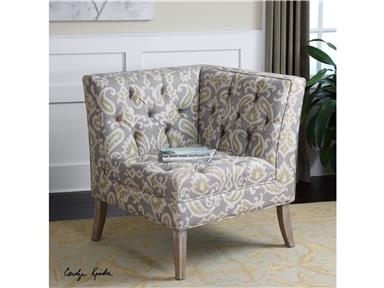
Living Room Uttermost Meliso Tufted Corner Chair 23167
Have you ever heard of the term Ikat? This is actually a kind of fabric that has been woven, dipped and dyed in almost the same way as tie-dyed stuff. The creation of Ikat prints is time consuming, hence, it was a symbol of power and wealth among Indonesians.
Ikat became available to interior design just a few years back. John Robshow, a famous fabric collector, as well as Madeline Weinrib, took Ikat and turned it into a high-end material. Soon, Oscar dela Renta also used the material on their scarves, bags, dresses and shoes.
The Ikat Technique
Ikat is a technique of resist dyeing that is used in making textile patterns. Resist dyeing often involves covering some parts of the fabric to shield them from the dye’s penetration. Thread is wound around the fabrics then wax is applied to the cloth’s surface (batik).
Ikat, in contrast, is a process done before weaving, warping or wefting. To come up with the patterns, the threads are first set on a frame. Several threads are then grouped then tied all at once. This results in knot units where the overall pattern made obvious.
Resist ties are then removed or some are added for every color. The combinations give birth to the designs. As the dyeing is completed, every single one of the resists is opened then the patterned yarns are finally woven.
Ikat is a Malay-Indonesian term for tie. Depending on whether tied fibers are used on the weft or warp, the technique can be called either as weft ikat or warp ikat. The double ikat is known as the third variety. This mixes the weft and warp tied resist.
The pattern becomes visible through the use of a major resist-dyed thread system. Warp ikat makes use of weave that is warp-faced while weft ikat has a weft-faced look.
Plain weave is best for showcasing the ikat design. Weft ikat which is a twill weave, can also be used.
Double ikat is ideally woven using a balanced weave, with weft and warp both visible. Any kind of textile fiber can be used to create ikat, though cotton and silk are quite common.
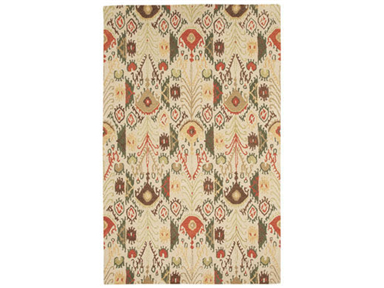
Capel Incorporated Floor Coverings Ikat 3′ x 5′ Rug 3261RS03000500800
More Ikat History
It is not established where and when the resist technique first came into existence. Asia comes with cultural regions with strong ikat culture. India, Central Asia and Maritime Southeast Asia are all candidates for where the technique originated.
Ikat could have evolved earlier, though. The Austronesian world also knows of this technique of tie dyeing. Madagascar and Indonesian ikat traditions seem to have similarities.
The earliest productions of ikat have also been seen in Peru, Chile, Guatemala, even Nigeria and Ghana. The Mediterranean region and Europe answered with ikat when Islamic textiles became renown. Italy soon welcomed this lovely print during the 17th century. The rest of Europe including Spain and France also started to produce these lovely prints.
The 19th and 20th centuries witnessed how Asia produced quality ikat textiles. Countries such as Japan, India and the rest of Asia produced these quality textiles in abundance. China, though famous for textile production, was not able to develop this technique.
India and the rest of Southeast Asia are the regions that offered more diverse ikat designs. Andhra Pradesh, Gujarat and Orissa proved to have their own ikat traditions. The sari-length silk cloths were soon manufactured in double ikat by Patan weavers.
Ikat designs, even to this day, require precision and a great amount of planning. If you have one in your home, then you are in possession of a piece that has weathered the test of time.
Tags: 19th century, 20th century, Asian design, Asian style, geometric patterns, ikat, ikat design, ikat patterns, ikat prints, Indian, McCreerys, McCreerys Home Furnishings, patterns
Posted in Interior Design 101, Interior Design Elements, Interior Design Themes | No Comments »
Friday, January 29th, 2016
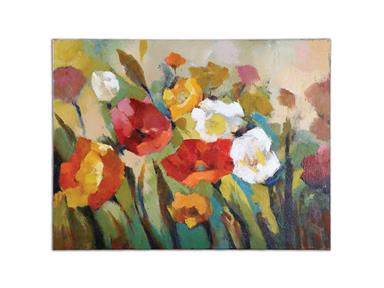
Accessories Uttermost Spring Has Sprung Floral Art 34268.
There is nothing more expressive when it comes to designing a home than the use of art. Art accessory comes in many forms but one of its most beautiful forms is a painting. Vibrant colors and rich textures can be infused with other design elements.
There are many media and styles featured in famous paintings, even repros. It is easy to find some pieces that can match your chosen theme and also your personality.
Watercolor paintings work best in achieving a softer look. This medium shows multiple layers of color ranging from abstract to life-like. For added contrast and detailed shading, find oil or acrylic paintings. These, on the other hand, feature mixed colors in various textures.
Painting History
The history of this art medium goes back a long way. Every style is born from the one that came ahead of it. Each artist also adds to the achievements of the early painters and is able to influence the next generation of painters.
Paintings can be enjoyed for their sheer beauty alone. But for the keen eye, their colors, forms, lines and composition appeal to every sense. Paintings can even leave lasting impressions.
The enjoyment of paintings is not the sole purpose of this kind of art. It can be used to convey a deeper message than mere beauty. It can express the artist’s impression of persons and scenes, even events. Feelings can also be described with the use of paintings. Viewers may or may not feel that emotions that are being conveyed by the artist. One needs a discerning eye for art in order to appreciate such things.
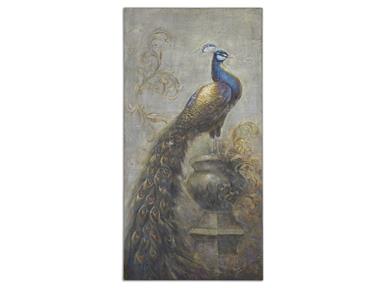
Accessories Uttermost Surveying The Kingdom Canvas Art 34283
Painting history can be encapsulated in these periods –
Man has gone a long way from the time when paintings were colored animal drawings inside caves. Cave dwellers were the first known painters, with their work found inside the caves of Spain and southern France.
Even back then, these cave artists knew that they needed vibrant colors to depict their lives back then. The famous painting of the wounded bison is still in the cave of Altamira in Spain today. While basic tools were used in the beginning, eventually, man learned to accumulate more materials and even learned techniques that improved his artwork.
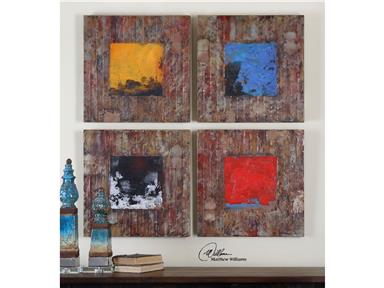
Accessories Uttermost Primary Blocks Wall Art S4 31303
You may not be able to take home an original Picasso, Monet or Michelangelo but there are still a lot of amazing paintings to go around. These days, the canvas can be the home for odd shapes, mere triangles, circles or rectangles in your sight but their bright colors and geometric patterns definitely mean something. It may even be difficult to distinguish between sculptures and paintings these days but the purity of hues and the shapes’ relationships are still there.
Artwork, as previously mentioned, comes in many forms. Clients are most familiar with the type that they can hang on walls inside their homes or offices. The next renowned pieces are tabletop artwork and sculptures.
Don’t get confused in choosing which medium you’d bring to your home or office. Just remember to show your personality through your chosen painting. Regardless of form, your taste and style should be reflected throughout the medium.
If you were a born optimist then it shouldn’t be a surprise to find brightly-colored paintings in your home. Black and white is for the stoic ones. What you have chosen based on your personality is a surefire validation that you have selected the right piece. Your art accessory is a representation of you so kudos!
Tags: 18th century, 19th century, 20th century, accent wall, art, art decor, artwork, choosing wall art, decorative painting, displaying artwork, history, McCreerys, McCreerys Home Furnishings, painting, paintings, Renaissance, rich hues, Rococo, shape, shapes, texture, textures, tips, wall decor
Posted in Accents, Decorative Elements, Interior Design Elements | No Comments »
Follow us on our social media


© McCreery's Home Furnishings | All Rights Reserved | Privacy Policy
