- Follow us:


Tuesday, October 17th, 2017

Tommy Bahama Home Bedroom St. Kitts Rattan Headboard 3_3 Twin 558-141HB: Nothing could be more ‘Asian’ or Filipino than rattan.
The islands of the Philippines is a tropical archipelago. Such a location can pose challenges in terms of interior design. Building a structure that can take extreme humidity and searing hot days can even add to the dilemma. As if these weren’t enough, the Philippine islands are even constantly bombarded with strong typhoons. All these require forward-thinking in terms of designing homes.
Enter passive cooling. This is a technique that many arid regions can adapt. This is when the design of the home was meant to bring in cool, fresh air. In the case of an Asian design such as the Filipino style, you can beautifully combine natural elements found in the beautiful islands with those of the modern aspects of many homes.
Ventilation Is Crucial
It is important to cross-ventilate. This should readily work with an open space concept so that entertaining guests becomes a lot easier. Orientation is just as crucial. Take into account all the elements such as the sun, wind, as well as where the natural shades are.
Let’s say a house is built diagonally with the majority of the service areas facing the southwest portion of the home. Now, these areas are where the sun is harshest. You can use window treatments to keep the brightness of the sun out during the hottest times of the day.
On the other hand, you can open these same curtains or draperies once the sun has gone easy. There is nothing new to be able to design in accordance with orientation. Most old homes in the Philippines have been built around lighting orientation.
High ceilings were also common in many homes whether among the rich or the poor. This design allows air to pass through and let in the maximum amount of natural light during the day.
Folding Doors
One other unique characteristic of old Filipino homes is the use of folding doors. These accordion type doors are big in the Philippines because they consume less space and they are easy to keep open during the day.
In a place where it can be extremely hot, it is needful to prop open the door so that the morning or afternoon breezes could freely move in.
Accordion doors cost less plus they can look great once you use the right materials. Traditional homes had wooden folding doors while the more modern ones have taken on the sliding, aluminum types.
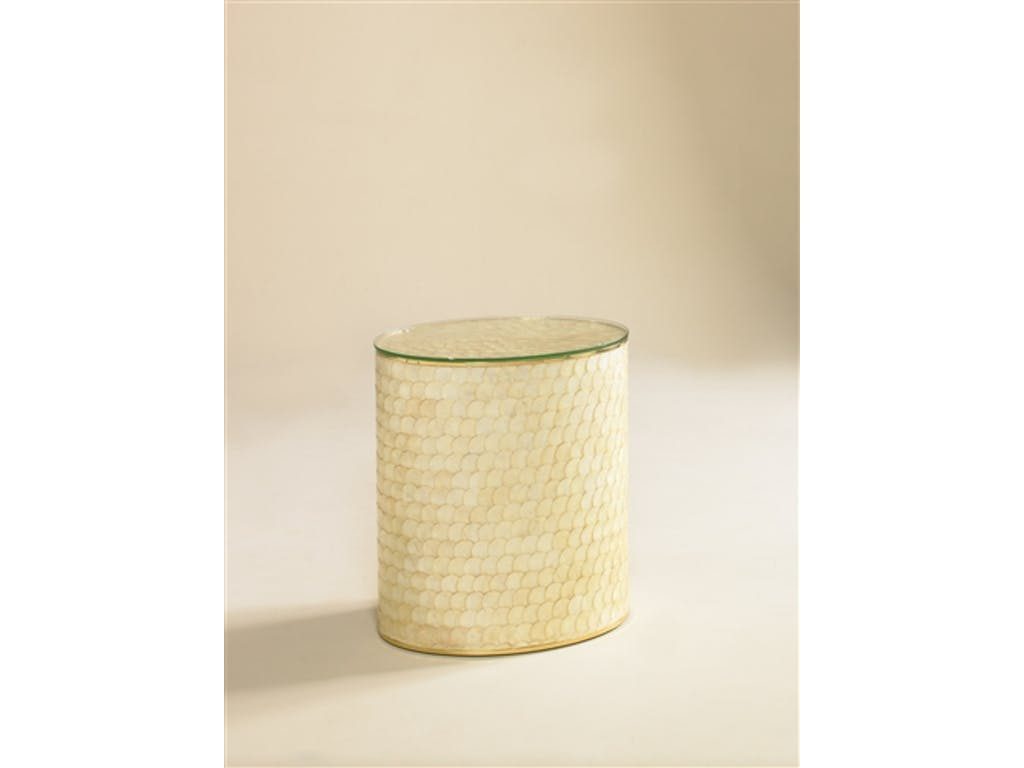
Maitland-Smith Living Room Capiz Shell Inlaid Occasional Table, Polished Brass Accents, Glass Top 3000-078: The term ‘Capiz’ came from a province in one of the islands of the Philippines.
Tile Flooring
The Philippines was under the Spanish rule for more than 300 years so it is not surprising that the people have been accustomed to all things Spanish. Tile flooring, for instance, is also common in many Filipino homes, especially those that have been handed down to them by their well-to-do half-Spanish relatives.
These old-money homes often have the reddish or terra cotta features of Spanish tiles. There are also distinct patterns in many of these homes. These same patterns, if you would observe, are also widely used in Spanish churches, museums, and colonial houses.
Cement tiles weigh about 1.7 to 4 kilos each. Depending on the size, though, you must be careful in installing these because they can be heavy. Mortar is often used to install these tiles while a sealer is used to fill the gaps.
Filipino Furnishings
As for the furnishings, Filipinos are fond of natural materials such as bamboo, Capiz shells, wood, and potted plants as ornaments. Colonial homes even have antique furniture handed down to them by their ancestors.
If you want to replicate this look, do so by working with a lot of woods, wicker, even water elements. The Filipinos have also traded with the Chinese and, in fact, have intermarried with this race so it is also fairly common to find Chinese elements fused into their interior design.
Tags: Asian design, Asian interior design, Asian style, Filipino design, Filipino interior design, Filipino style, McCreerys, McCreerys Home Furnishings
Posted in Interior Design 101, Interior Design Elements, Interior Design Themes | Comments Off on Have You Heard of the Filipino Interior Design?
Friday, February 12th, 2016
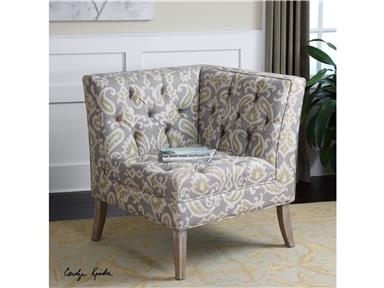
Living Room Uttermost Meliso Tufted Corner Chair 23167
Have you ever heard of the term Ikat? This is actually a kind of fabric that has been woven, dipped and dyed in almost the same way as tie-dyed stuff. The creation of Ikat prints is time consuming, hence, it was a symbol of power and wealth among Indonesians.
Ikat became available to interior design just a few years back. John Robshow, a famous fabric collector, as well as Madeline Weinrib, took Ikat and turned it into a high-end material. Soon, Oscar dela Renta also used the material on their scarves, bags, dresses and shoes.
The Ikat Technique
Ikat is a technique of resist dyeing that is used in making textile patterns. Resist dyeing often involves covering some parts of the fabric to shield them from the dye’s penetration. Thread is wound around the fabrics then wax is applied to the cloth’s surface (batik).
Ikat, in contrast, is a process done before weaving, warping or wefting. To come up with the patterns, the threads are first set on a frame. Several threads are then grouped then tied all at once. This results in knot units where the overall pattern made obvious.
Resist ties are then removed or some are added for every color. The combinations give birth to the designs. As the dyeing is completed, every single one of the resists is opened then the patterned yarns are finally woven.
Ikat is a Malay-Indonesian term for tie. Depending on whether tied fibers are used on the weft or warp, the technique can be called either as weft ikat or warp ikat. The double ikat is known as the third variety. This mixes the weft and warp tied resist.
The pattern becomes visible through the use of a major resist-dyed thread system. Warp ikat makes use of weave that is warp-faced while weft ikat has a weft-faced look.
Plain weave is best for showcasing the ikat design. Weft ikat which is a twill weave, can also be used.
Double ikat is ideally woven using a balanced weave, with weft and warp both visible. Any kind of textile fiber can be used to create ikat, though cotton and silk are quite common.
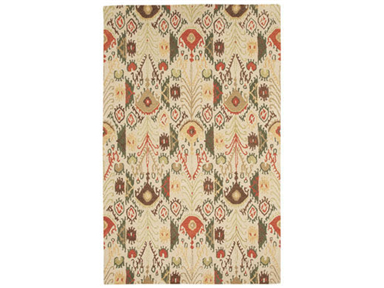
Capel Incorporated Floor Coverings Ikat 3′ x 5′ Rug 3261RS03000500800
More Ikat History
It is not established where and when the resist technique first came into existence. Asia comes with cultural regions with strong ikat culture. India, Central Asia and Maritime Southeast Asia are all candidates for where the technique originated.
Ikat could have evolved earlier, though. The Austronesian world also knows of this technique of tie dyeing. Madagascar and Indonesian ikat traditions seem to have similarities.
The earliest productions of ikat have also been seen in Peru, Chile, Guatemala, even Nigeria and Ghana. The Mediterranean region and Europe answered with ikat when Islamic textiles became renown. Italy soon welcomed this lovely print during the 17th century. The rest of Europe including Spain and France also started to produce these lovely prints.
The 19th and 20th centuries witnessed how Asia produced quality ikat textiles. Countries such as Japan, India and the rest of Asia produced these quality textiles in abundance. China, though famous for textile production, was not able to develop this technique.
India and the rest of Southeast Asia are the regions that offered more diverse ikat designs. Andhra Pradesh, Gujarat and Orissa proved to have their own ikat traditions. The sari-length silk cloths were soon manufactured in double ikat by Patan weavers.
Ikat designs, even to this day, require precision and a great amount of planning. If you have one in your home, then you are in possession of a piece that has weathered the test of time.
Tags: 19th century, 20th century, Asian design, Asian style, geometric patterns, ikat, ikat design, ikat patterns, ikat prints, Indian, McCreerys, McCreerys Home Furnishings, patterns
Posted in Interior Design 101, Interior Design Elements, Interior Design Themes | No Comments »
Follow us on our social media


© McCreery's Home Furnishings | All Rights Reserved | Privacy Policy
