- Follow us:


Friday, February 12th, 2016
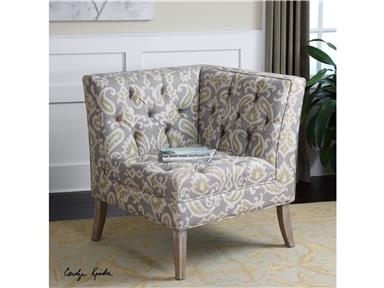
Living Room Uttermost Meliso Tufted Corner Chair 23167
Have you ever heard of the term Ikat? This is actually a kind of fabric that has been woven, dipped and dyed in almost the same way as tie-dyed stuff. The creation of Ikat prints is time consuming, hence, it was a symbol of power and wealth among Indonesians.
Ikat became available to interior design just a few years back. John Robshow, a famous fabric collector, as well as Madeline Weinrib, took Ikat and turned it into a high-end material. Soon, Oscar dela Renta also used the material on their scarves, bags, dresses and shoes.
The Ikat Technique
Ikat is a technique of resist dyeing that is used in making textile patterns. Resist dyeing often involves covering some parts of the fabric to shield them from the dye’s penetration. Thread is wound around the fabrics then wax is applied to the cloth’s surface (batik).
Ikat, in contrast, is a process done before weaving, warping or wefting. To come up with the patterns, the threads are first set on a frame. Several threads are then grouped then tied all at once. This results in knot units where the overall pattern made obvious.
Resist ties are then removed or some are added for every color. The combinations give birth to the designs. As the dyeing is completed, every single one of the resists is opened then the patterned yarns are finally woven.
Ikat is a Malay-Indonesian term for tie. Depending on whether tied fibers are used on the weft or warp, the technique can be called either as weft ikat or warp ikat. The double ikat is known as the third variety. This mixes the weft and warp tied resist.
The pattern becomes visible through the use of a major resist-dyed thread system. Warp ikat makes use of weave that is warp-faced while weft ikat has a weft-faced look.
Plain weave is best for showcasing the ikat design. Weft ikat which is a twill weave, can also be used.
Double ikat is ideally woven using a balanced weave, with weft and warp both visible. Any kind of textile fiber can be used to create ikat, though cotton and silk are quite common.
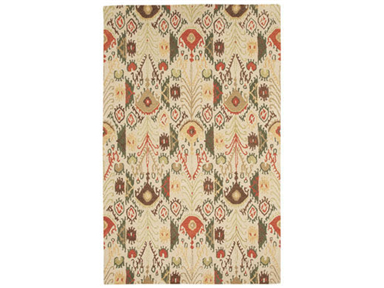
Capel Incorporated Floor Coverings Ikat 3′ x 5′ Rug 3261RS03000500800
More Ikat History
It is not established where and when the resist technique first came into existence. Asia comes with cultural regions with strong ikat culture. India, Central Asia and Maritime Southeast Asia are all candidates for where the technique originated.
Ikat could have evolved earlier, though. The Austronesian world also knows of this technique of tie dyeing. Madagascar and Indonesian ikat traditions seem to have similarities.
The earliest productions of ikat have also been seen in Peru, Chile, Guatemala, even Nigeria and Ghana. The Mediterranean region and Europe answered with ikat when Islamic textiles became renown. Italy soon welcomed this lovely print during the 17th century. The rest of Europe including Spain and France also started to produce these lovely prints.
The 19th and 20th centuries witnessed how Asia produced quality ikat textiles. Countries such as Japan, India and the rest of Asia produced these quality textiles in abundance. China, though famous for textile production, was not able to develop this technique.
India and the rest of Southeast Asia are the regions that offered more diverse ikat designs. Andhra Pradesh, Gujarat and Orissa proved to have their own ikat traditions. The sari-length silk cloths were soon manufactured in double ikat by Patan weavers.
Ikat designs, even to this day, require precision and a great amount of planning. If you have one in your home, then you are in possession of a piece that has weathered the test of time.
Tags: 19th century, 20th century, Asian design, Asian style, geometric patterns, ikat, ikat design, ikat patterns, ikat prints, Indian, McCreerys, McCreerys Home Furnishings, patterns
Posted in Interior Design 101, Interior Design Elements, Interior Design Themes | No Comments »
Follow us on our social media


© McCreery's Home Furnishings | All Rights Reserved | Privacy Policy
