- Follow us:


Friday, January 29th, 2016
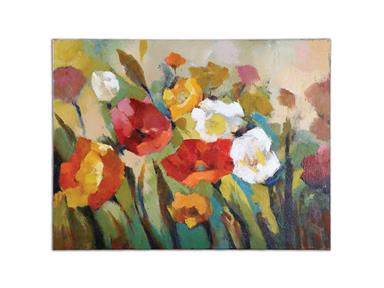
Accessories Uttermost Spring Has Sprung Floral Art 34268.
There is nothing more expressive when it comes to designing a home than the use of art. Art accessory comes in many forms but one of its most beautiful forms is a painting. Vibrant colors and rich textures can be infused with other design elements.
There are many media and styles featured in famous paintings, even repros. It is easy to find some pieces that can match your chosen theme and also your personality.
Watercolor paintings work best in achieving a softer look. This medium shows multiple layers of color ranging from abstract to life-like. For added contrast and detailed shading, find oil or acrylic paintings. These, on the other hand, feature mixed colors in various textures.
Painting History
The history of this art medium goes back a long way. Every style is born from the one that came ahead of it. Each artist also adds to the achievements of the early painters and is able to influence the next generation of painters.
Paintings can be enjoyed for their sheer beauty alone. But for the keen eye, their colors, forms, lines and composition appeal to every sense. Paintings can even leave lasting impressions.
The enjoyment of paintings is not the sole purpose of this kind of art. It can be used to convey a deeper message than mere beauty. It can express the artist’s impression of persons and scenes, even events. Feelings can also be described with the use of paintings. Viewers may or may not feel that emotions that are being conveyed by the artist. One needs a discerning eye for art in order to appreciate such things.
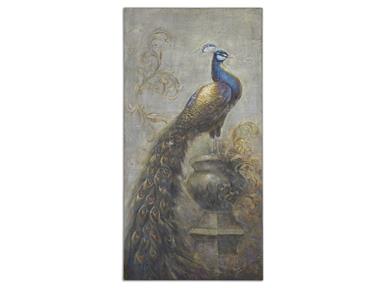
Accessories Uttermost Surveying The Kingdom Canvas Art 34283
Painting history can be encapsulated in these periods –
Man has gone a long way from the time when paintings were colored animal drawings inside caves. Cave dwellers were the first known painters, with their work found inside the caves of Spain and southern France.
Even back then, these cave artists knew that they needed vibrant colors to depict their lives back then. The famous painting of the wounded bison is still in the cave of Altamira in Spain today. While basic tools were used in the beginning, eventually, man learned to accumulate more materials and even learned techniques that improved his artwork.
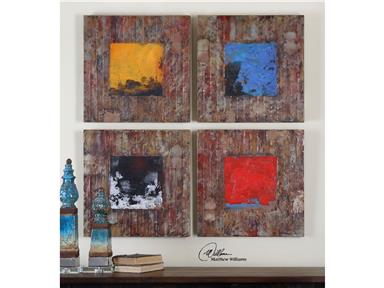
Accessories Uttermost Primary Blocks Wall Art S4 31303
You may not be able to take home an original Picasso, Monet or Michelangelo but there are still a lot of amazing paintings to go around. These days, the canvas can be the home for odd shapes, mere triangles, circles or rectangles in your sight but their bright colors and geometric patterns definitely mean something. It may even be difficult to distinguish between sculptures and paintings these days but the purity of hues and the shapes’ relationships are still there.
Artwork, as previously mentioned, comes in many forms. Clients are most familiar with the type that they can hang on walls inside their homes or offices. The next renowned pieces are tabletop artwork and sculptures.
Don’t get confused in choosing which medium you’d bring to your home or office. Just remember to show your personality through your chosen painting. Regardless of form, your taste and style should be reflected throughout the medium.
If you were a born optimist then it shouldn’t be a surprise to find brightly-colored paintings in your home. Black and white is for the stoic ones. What you have chosen based on your personality is a surefire validation that you have selected the right piece. Your art accessory is a representation of you so kudos!
Tags: 18th century, 19th century, 20th century, accent wall, art, art decor, artwork, choosing wall art, decorative painting, displaying artwork, history, McCreerys, McCreerys Home Furnishings, painting, paintings, Renaissance, rich hues, Rococo, shape, shapes, texture, textures, tips, wall decor
Posted in Accents, Decorative Elements, Interior Design Elements | No Comments »
Monday, January 18th, 2016
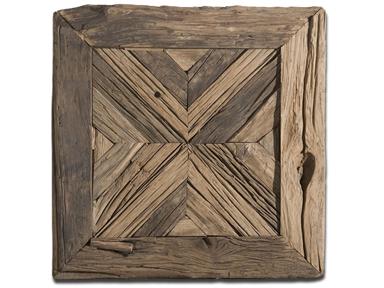
Uttermost Accessories Rennick Metal Wall Art 04014 at McCreerys Home Furnishings. Reclaimed pine wood was used in the creation of this unique wall art.
Artists are fully aware that the term art deco came from the Exposition Internationale des Arts Decoratifs Industriels et Modernes in 1925, held in Paris, France. French artists then collaborated to come up with the show. Emile Decour, Hector Guimard, Eugene Grasset, Paul Follot, Raoul Lachenal and Maurice Dufrene were previously into Art Nouveau before they came up with the new show. Art deco was not that popular till Bevis Hillier, an art historian and critic, mentioned it in her book entitled Art Deco of the 20s and 30s in 1968.
Enough with art deco history; of course you would want to know how you can set up a purely decorative theme in your home.
Art Deco Features and Materials
The use of new building materials that were altered to other styles is what separated art deco from Art Nouveau. This kind of architecture showed scientific progress, technology, speed and the rise of commerce.
Combine these revolutionary characteristics with opulent, modern style and what you have is art deco in its purest form. To further picture what this style is all about, try to visualize the lavish interiors and architecture of cinemas, U.S. train stations and ocean liners like the Queen Mary. The simplicity of their designs is what made them endure even the Great Depression. This only means that your choice is a design that is timeless.
Art deco structure is fundamentally about geometric shapes from the Greco-Roman Classicism. You can also find the multi-faceted architecture of Assyria, Babylon, Aztec Mexico and Ancient Egypt. Think of monumental structures and skyscrapers, music halls, find trapezoids, triangles, zigzags, sweeping curves, and chevron patterns.
It is also not surprising to find new materials like stainless steel, aluminum, plastics, inlaid wood and lacquer. You can find these new materials fused with horn, moulded glass, ivory, and exotic stuff like zebra or shark skin.
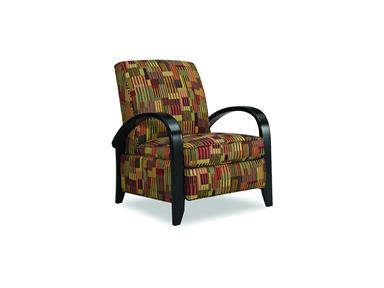
Sam Moore Living Room Steamer Recliner 5560 features sleek arm rests yet an artistic fabric. This fine fusion of simplicity and artistry is what makes this living room furniture a must-have piece.
Art Deco Applications
Art deco is commonly seen in poster art, jewelry textiles, fashion, furniture, architecture and interior design. This style is also applied in graphics and painting.
Art deco design are now adopted by so many architects all over the world ranging from Australia, Romania, Argentina, India, the Philippines, the United Kingdom, Brazil, Cuba, to Spain. American art deco is evident in structures such as the Chrysler Building, News Building, Rockefeller Center, The Empire State Building, and the Chanin Building.
If you love the reappearance of art deco in interiors, then you are not alone. Many homeowners now embrace this style by using bold, geometric patterns. Curvilinear and rectilinear forms are also iconic forms used in art deco interiors. These can make any room come alive almost instantly.
Travel and tourism were quite popular in the 1930s, hence, the addition of African safaris and other exotic finishes to art deco was inevitable. So go ahead and use shiny fabrics, glass, mirrors and metallic paints in your home.

The Accessories Uttermost Bonjour Wall Art 13857 is an awesome replica of the 1800s French correspondence letter. It is perfectly framed in an antique mirror and a distressed dark-colored frame.
And what is art deco without artwork and sculptures? As the name of this style suggests, you should showcase the arts and the world of entertainment. Use sculptural lamps, the boldest oil paintings that you can find, and ornate bedroom furniture. Detailed furniture will surely bring in the art deco elements that you need for your home.
Using the term bold is surely an understatement when talking about the high contrast colors used in art deco. In your kitchen or bathroom, use finishes and tiles that revive the artistic vibe. Monochromatic black combined with white, deep brown or bright reds will surely look gorgeous.
Bring in some high gloss porcelain and ceramic tiles, bold fabrics, to finish off with a dramatic art deco flair.
Tags: art, art deco, artwork, bold, bold statement, displaying artwork, displaying works of art, geometric, geometric design, geometric elements, geometric furniture, geometric patterns, McCreerys, McCreerys Home Furnishings, metals, patterns, textiles, tips, wood
Posted in Furniture, Interior Design 101, Interior Design Elements, Interior Design Themes | No Comments »
Follow us on our social media


© McCreery's Home Furnishings | All Rights Reserved | Privacy Policy
