- Follow us:


Tuesday, January 3rd, 2017
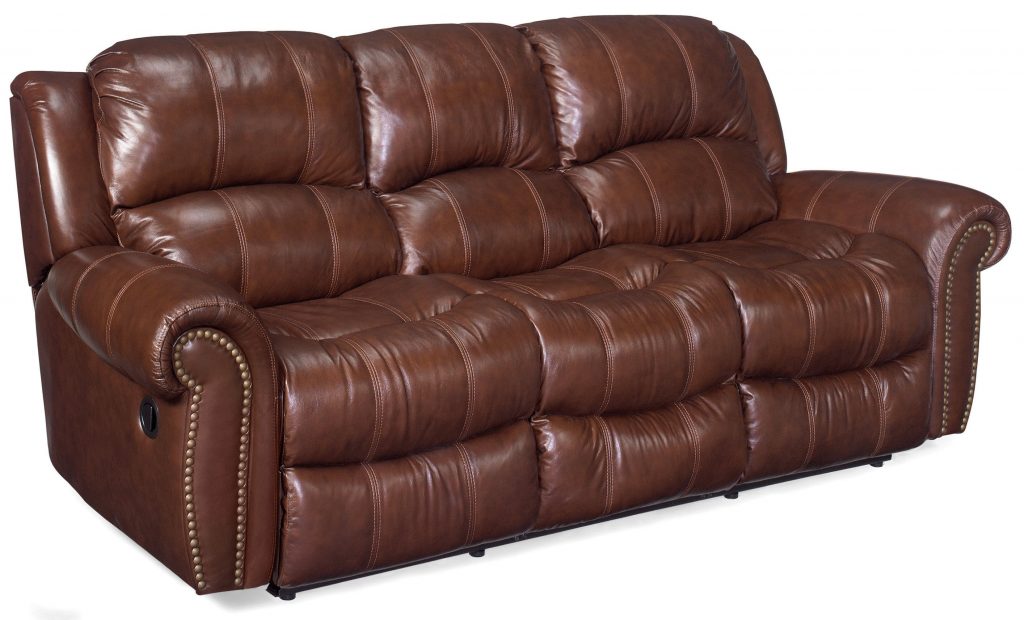
Hooker Furniture Living Room Sebastian Sofa (with 2 Recliners)
Upholstered furniture go through the same rigors as cabinetry and other pieces of furniture. The only difference is that you may not always notice the dust that settles on upholstered pieces. Brushing or vacuuming every week in order to remove dust as well as avoid colors becoming dull is one of the many effective ways of caring for leather and upholstered pieces.
Why Care for Leather?
In the first place, why? Leather is a beautiful, natural product. This is one of the few materials that allows the piece to breathe while delivering warm and unique characteristics.
Leather beautifully displays traces of where it came from – the scars, brands, growth and creases show it all. These add character to the couch and do not affect the overall quality of the furniture piece.
Leather is resilient, durable and has a patina that develops over time which increases its appeal.
Tips in Leather Care
Begin by protecting your leather couch from direct sunlight. It is best to use leather pieces indoors or any area that would allow them to sit without being touched by the rays of sunlight.
Dust can be removed from semi-aniline, protected or pigmented leather through vacuuming. You can then follow this process by wiping them with a slightly damp piece of cloth. You can also use mild soap if grease has accidentally touched your leather piece.
Follow up with buffing using a soft, dry cloth. Avoid rubbing or wetting excessively.
Next, it is common for leather to have natural oils and perspiration coming from the hair and skin. These can have an effect on the leather couch’s finish. The degree of this said effect can vary from one person to the next. Cleaning is best done where the bare hands, arms and heads usually rest. Do this a couple of times each week.
You can also use leather protection cream to better protect your leather couch. Apply it to both new and used leather from two to four times every year. There are also soft leather cleaners which can be used more often as needed. When cleaning, make sure that you don’t rub the cleaner, instead, use a soft, wiping motion.
Another problem with leather couch ownership is when ink marks stain the lovely piece. Find a ball point pen ink remover that could penetrate more deeply than the usual cleaners. When the stain is a tad more serious, it may require you to ask for professional help.
When it comes to hide food, here’s a word of caution – do not use it to polish your leather couch. Instead, use the usual leather creams and cleaning solutions.
Nubuck, suede, and aniline leathers ask for specific care since they all lack protective coating. Find products that were specifically manufactured for these kinds of leather finish. Make sure that you follow the cleaning instructions thoroughly. Be sure to test on an unseen part of the couch before you begin the cleaning process.
Another warning when it comes to owning leather furniture is to keep it away from any heat source. Keep a distance of 30 cm from the leather couch and the radiator (or any other heat source).
As for liquids, quickly find some absorbent paper towels then dab the area where there was a spillage. Use clean towels to completely dry the area afterwards.
Plump the back and arm cushions as well as the seats and fixed pads so that they maintain their shape for years. Should you notice any crease especially on the seat area, be sure to smooth them out so that it won’t become a permanent problem.
Lastly, just be gentle when sitting on your leather couch so that it will be with you for a long, long time.
Tags: caring for leather, leather care, leather couch, leather furniture, leather furniture care, leather maintenance, McCreerys, McCreerys Home Furnishings
Posted in Furniture, Home Maintenance, Interior Design 101, Interior Design Elements | Comments Off on Caring for That Leather Couch
Saturday, January 30th, 2016
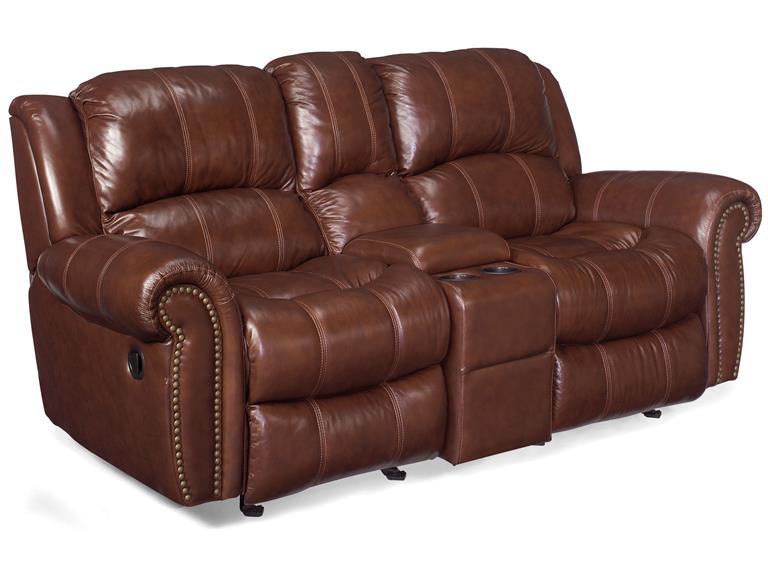
Hooker Furniture Living Room Cognac Entertainment Sofa with 2 Glider Recliner-Stg Console
For hundreds of years now, cattle hide was used to cover books, even to bind them. Cowboys from the West also used this material as a huge part of their outfit. Later on, leather became a luxurious addition to pricey car interiors. Today, it has dominated the world of fashion and interior design.
Many people just dream of owning a leather sofa situated inside their spacious family room. The smooth Italian leather can be used on a long sectional or that cute ottoman.
Leather can be mixed and matched or you can just pick a piece to balance the fabrics in a room.
Leather furniture pieces have the capacity to stand on their own in terms of aesthetic appeal and quality. Mix it with other fabrics or use it as base for fabric or silk covered cushions. It can also add a twist to your home if you use it on architectural detailing or finishing.
Leather has gone a long way from being a cowboy hat or boot. It is now the star of many furniture shops. McCreery’s Home Furnishings offers the best leather sofas and chairs. If you want to go beyond furniture pieces in utilizing this wonderful material, then have it installed as a part of your flooring or walls.
Wood wainscoting may be a lovely design idea but you can surprise everyone by using leather tiles. What you will get is a unique and sophisticated look. You will be amazed on how this wall finishing can make a bland place appear more elegant if not sophisticated.
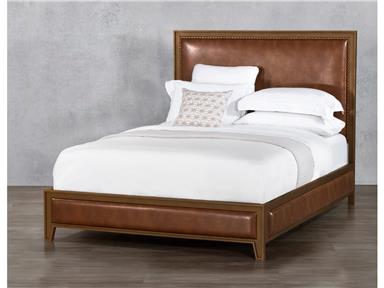
Wesley Allen Bedroom Headboard with Surround HB1231. Who says leather should only be installed on sofas?
As to interior decor, there isn’t a material out there that can be more adaptable than the good old leather. It is versatile, meaning, you have the leeway to use it in modern settings or on timeless dwellings.
This is a wonderful neutral piece that should be used sparingly. It can be easily mixed and matched with different furniture groups which consist of upholstered pieces. Remember that too much leather can also make a room appear daunting and cold. Avoid this result by including just a single leather furniture as a feature piece. You can finish off with colorful accent pillows.
Leather also gets better with age so you won’t have to worry about replacing it soon. Leather furniture bought today will look amazingly wonderful two decades from now.
Shopping for Leather Furniture
Not all leather items come with the same standard. Some leather grades have a higher quality than the rest that are being sold in the market so it is up to you to distinguish which ones you will take home.
Identifying genuine leather is a matter of getting used to the touch and appearance of this material.
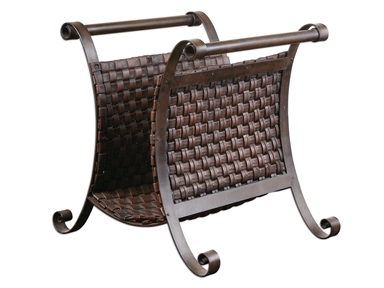
Uttermost Accessories Brunella, Magazine Holder 19543. This living room piece depicts class and elegance
Full grain leather is the la creme dela creme of all leathers. This is also the toughest kind. A basic way to find out full grain leather is to search for scars and other small imperfections. If nothing has been done to hide such, then these natural imperfections will point to the genuineness of the material.
Top grain, on the other hand, is a notch below full grain. The split layer is taken off from the layer of the top grain. Majority of the imperfections have been removed, thus, making the piece look a tad like plastic.
Corrected grain leather is manufactured hides that contain bite marks, scars and many imperfections. Such imperfections are unsuitable for sofas, hence, they were removed through buffing and pigmentation.
Lastly, faux leather can also be a great alternative but your concerted effort should be centered on inspecting edges, examining the pores, and touching the skin. Real leather can have a course feel and it has a distinct smell that can never be replicated in any manufacturing shop.
Tags: genuine leather, history, history of leather, leather, leather couch, leather design, leather furniture, leather shopping, leather sofa, leather upholstery, McCreerys, McCreerys Home Furnishings
Posted in Interior Design Elements, Interior Design Themes | No Comments »
Follow us on our social media


© McCreery's Home Furnishings | All Rights Reserved | Privacy Policy
