- Follow us:


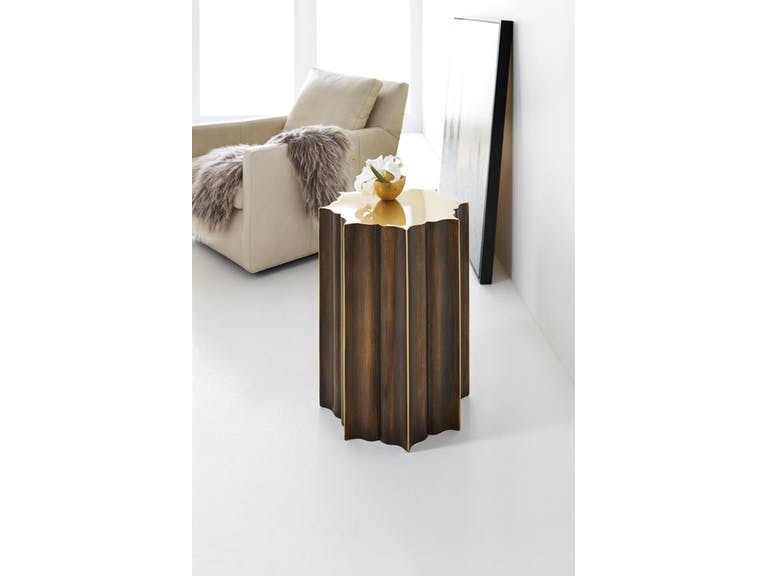
Hooker Furniture Living Room Melange Eden Drink Table is coming very soon!
Color theory is an all-encompassing definition of concepts and designs. There are three categories, though, that can be logically used in fashion or interior design. You have, of course, already heard of the color wheel, the color harmony, and how each color is used according to context.
Color theories are there for a structural comprehension of hues. For instance, if you see a table laden with fabrics, then you can categorize according to color.
How to Use the Color Wheel
Also known as the color circle, this is based on yellow, red, and blue which are the traditional, basic colors. Sir Isaac Newton was the first to develop the circular diagram in 1666. Scientists and artists, since then, have come up with designs and variations based on the said diagram.
The color wheel is a representation of the logical arrangement of hues in their purity. First, take a look at the primary colors. These cannot be formed when you mix other colors. These are self-sustaining hues and are used to create other hues.
The secondary colors, on the other hand, are formed as you mix the primary colors. When you mix red and yellow, you end up with orange. Purple – which is the color of 2018 – can be made by fusing red with blue. Mixing yellow and blue means you will have a green hue soon.
Tertiary colors are red-orange, yellow-orange, red-purple, blue-purple, yellow-green and blue-green. These are made by mixing a primary color with a secondary color, hence, the two-color names.
What Is Color Harmony?
Harmony is the pleasant arrangement of music, color or poetry. When pertaining to visual experiences, this is one that pleases the beholder. It must be able to engage the viewer and create a sense of balance or order.
When was the last time that you saw something that was not in harmony with something else? You would probably define that space as chaotic or boring. Either way, you were not pleased with what you saw so your brain rejected the image.
There are formulas to follow with regard to color harmony. There are color schemes that come from analogous hues. These are colors that sit side-by-side on the color wheel such as yellow-green, yellow, and the exciting yellow-orange.
If you want to use two colors that are seated opposite from each other, then what you want are complementary colors. An example of these is green and red as well as yellow-green and red-purple. The two colors may seem to oppose but they actually provide the needed contrast as well as optimized stability.
If you want to use additive colors, then you would want the primary hues that make up the white light. These are green, red, and blue or RGB. Subtractive primary colors, on the other hand, uses a color-printing process referred to as the CMYK or the use of cyan, magenta, yellow, and black.
Tints are mixtures of any color with white while shades are mixtures of any color with black. Toning is the creation of anything that is grayed down (white and black are both added to a hue). There are three ways to alter the basic color wheel and these are to tint, shade or tone.
The 60-30-10 Rule
The key to being confident in combining colors is to use this simple rule. This concept follows the rule of three which is used in almost everything from marketing to writing and even floral arrangements.
This is not a precise formula, okay, so relax. Don’t go all matchy-matchy, just be careful with cohesion and balance.
The 60 in this rule stands for 60% of the room should be occupied by anchor pieces and walls. The next 30% should be for accent furniture, wood trim, area rugs, and textiles, while the last 10% is for artwork, decorative pieces, and other small items.
Follow us on our social media


© McCreery's Home Furnishings | All Rights Reserved | Privacy Policy
