- Follow us:


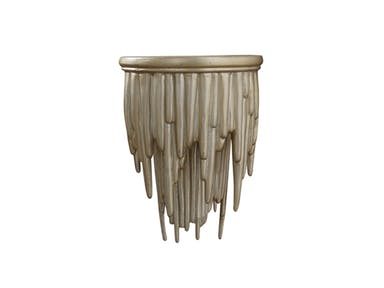
The Maitland-Smith Accessories Silver Gilded Cast Resin Wall Bracket Wall Decor 1443-249 comes to mind when speaking of brutalistic roughness.
Le Corbusier, a modernist architect, is the one who’s prominently attributed to the birth of an architectural and interior design theme that is now known as brutalism. This style was immediately loved by many British architects.
Looking at it then (and, yes, even now), it was a look that was strange especially since modern architecture was not immediately popular in Britain. Brutalism sort of unintentionally replaced modern architecture when it was not assimilated into modernist structures.
Brutalism can be defined as an alternative to modern architecture but in a more animated and noticeable manner. There are even some who would argue that it is a fusion of architectural Modernism and Postmodernism.
Not Totally Le Corbusier
Yet it would be unfair to attribute brutalism totally to just one professional. There are many versions of this story which makes it difficult to pinpoint its exact birth and who its real creator was.
Please don’t think of brutality as the basis for brutalism as it was not intended to be ascribed to this term. It could have come from béton-brut, a French term which means raw concrete. It could also have been the creation of Hans Asplund, a Swedish architect, who concocted the term – New Brutalism.
Do you now see the whole point of this style? It has no exact origin or well-defined precursors. A third version of brutalism’s history is that Brutus decided the movement’s name. Brutus was, of course, the renowned architect Peter Smithson.
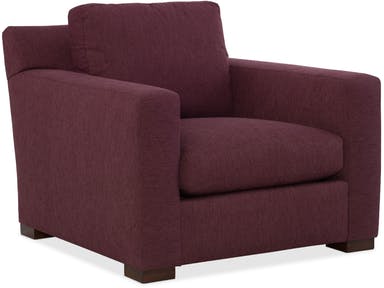
As solid and fortress-like as the brutalistic structures are, so is the Sam Moore Living Room Sage Chair SM10-005.
So What Really Is Brutalism?
Villa Goth, previously linked to brutalism, is a house in the city of Uppsala in Sweden. While it was originally thought to represent brutalism, today, it is considered not a representation of this style.
Peter Smithson and his wife Alison were the leading brutalism figures in Great Britain as was Emo Goldfinger, a Hungarian architect. The latter designed the famed Balfron and Trellick Towers which are famed for their representation of the brutalist movement.
If there’s one thing that’s constant in all brutalist forms or structures, this would have to be the use of concrete. This material is basic and pliable. It can provide any form that you would want it to become. Yet, again, there is more to this style than merely using a constructive material. It needs a mold so it can be the shape that you require of it.
Brutalist ideology is also all about honesty and bare essence, hence, concrete is used on building’s façades. Before there was brutalism, concrete was used elsewhere – where it cannot be seen. More often than not, it is encased in glass or steel.
Well, no more hiding behind the mask. In the ‘60s and the ‘70s, brutalistic architecture flourished. Communist nations with their concrete suburban blocks housed many individuals. Tall buildings were then made and most were linked with futurism.
Brutalism Today
Brutalism is not just Le Corbusier neither is it just concrete. It is not ugly yet neither is it instantly beautiful to the beholder. In any case, today’s generation can now see past the monstrous blocks and the solid hues that often represent brutalism. Concrete has been used to show its innate qualities, one of straightforwardness.
Maybe we can say that the world was not ready for the brutalist design back in the day but, today, everyone is more than ready. Owen Hatherley, a British writer, even quoted Park Hill (a building complex) in Sheffield. This was supposed to be demolished but was saved from this fate.
Instead, Park Hill was revitalized and it represented the beauty of brutalism – it brought back the personality, vision and optimism to that place.
Brutalist furniture, in case you’re wondering, are the pieces that are rough around the edges yet they present a seemingly fortress-like look. If you’re ready for these pieces, then be sure to have the rest of the design is strong enough to support ‘em.
Follow us on our social media


© McCreery's Home Furnishings | All Rights Reserved | Privacy Policy
