- Follow us:


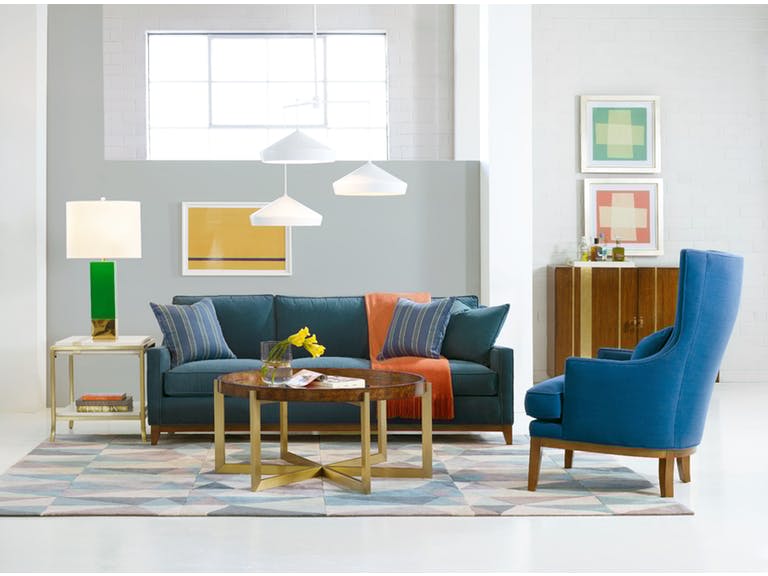
Cynthia Rowley Horizon Line Round Metal Cocktail Table is simple and suitable for this casual, contemporary home.
Contemporary design is not modern design – let’s make that clear, okay? These two are often confused, though. There are some elements of modern design that are found in contemporary style but they have their stark differences, too.
Let’s examine, carefully, what makes contemporary style a lot different from its predecessor.
By Definition
Bring down that dictionary from the shelf and search for the word contemporary. This term is defined as “living, occurring at the exact same time”. It is also seen as occurring at present.
Basically, contemporary means at the moment.
Seeing the Line of Demarcation
It is interesting to note that a lot of people interchange contemporary with modern design. Modern design is generally referring to the mid-1900s design. Its features include expansive spaces, neutrals, natural materials, clean lines and pops of bright colors. Low lines are also apparent.
Modern design is also geared towards functionality or practicality. For something to be referred to as modern, it must have a functional form. This means clean lines, open space layouts, and to some degree, innovation.
Contemporary style came to the scene near the ‘80s. It was during the late 1970s when various styles were mixed including modernism, post-modernism, Art Deco, De-constructivism and Futurism.
Current designs are contemporary designs, that’s all there is to it. Moving forward, the design elements that we see today may be referred to as something else. It could be the 21st century design or whatnot.
The reason behind the confusion lies in the similarities between Modern and Retro Modern elements. The former has evergreen elements, though, while the latter is minimalistic.
Contemporary style is ever-evolving. It can easily relate to many styles no matter what kind you would like to put on your plate. Any space can have contemporary elements because of the very nature of this theme.
Contemporary living means saying yes to shifting preferences, changing styles and tastes, and evolutionary pieces.
Your Home’s Contemporary Needs
Light. The emergence of Modern and Post-modern designs in the 1920s till the 1960s brought with it larger rooms. These are a far cry from the closed-off and small windows from the previous era.
Airy and light rooms began to replace the darker ones. Skylights, translucent glass windows and solar tubes became ever popular.
Subtlety. Whether you’re thinking about the colors that you would use or the accents. Use grays, black, browns and whites for your furnishings, flooring, textiles and lighting fixtures.
Natural elements. Instead of defaulting to wood, why not experiment with leather, wool, cotton, slate, teak and rock? Use these to give the interior and exterior parts of your home a natural look. Contemporary doesn’t always have to be plastic, you know.
Breeziness. Don’t go for stuffy or heavy atmosphere. Ornamentation must not be a part of your theme. See if you could have the kind of furniture that is raised off the floor. This will give the pieces a look of weightlessness.
Dare to bare. Another contemporary element is living with less. This means learning to live with bare flooring with lovely finishes such as ceramic, hardwood or porcelain tiles. It would also be a great idea to include an area rug. This will make your underfoot a lot more comfy.
Open floor layout. Contemporary habitats often have a grand look because they have non-obvious boundaries. The open space layout is common inside such homes, thus, all the living spaces are unified yet separation lines are there somewhere – you can still feel them.
Streamlined. Contemporary homes say no to curvilinear furniture pieces. For a contemporary appeal, use distinct lighting fixtures with simple hand railings, banisters, and simple art. Minimalism is key to contemporary living.
Follow us on our social media


© McCreery's Home Furnishings | All Rights Reserved | Privacy Policy
